How to Calculate Square Footage of a Room (All Room Shapes Covered)
For a standard room, square footage equals length in feet times width in feet. A 14 ft by 11 ft room is 154 sq ft. Real rooms are not always rectangles, so this guide shows how to measure nine room shapes before you buy flooring, carpet, tile, paint, or furniture.
Use the general how to calculate square footage guide for broad formulas. Use how to calculate square footage of a house for whole-home real estate questions. This page stays with one room and the buying decisions that follow.
The Quick Formula for Standard Rooms
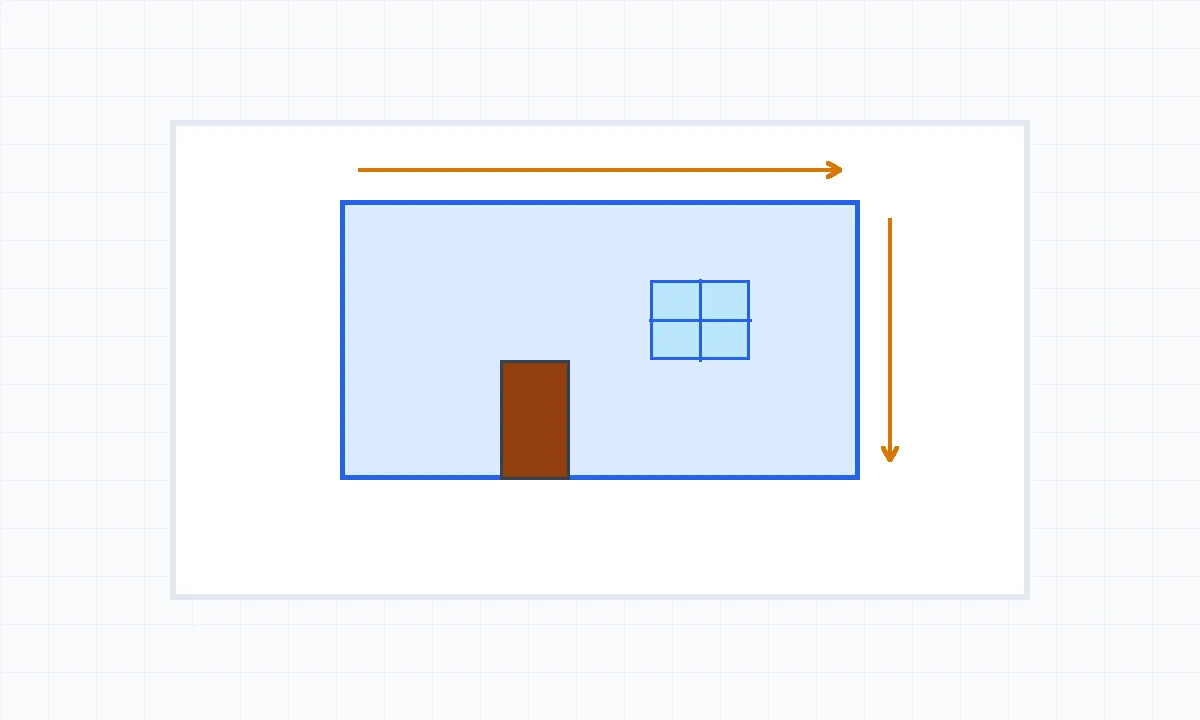
Square footage = length (ft) x width (ft). Measure the longest wall, measure the perpendicular wall, then multiply. A room that is 14 ft long and 11 ft wide is 14 x 11 = 154 sq ft.
- 1
Measure the length of the room, usually the longest wall.
- 2
Measure the width on the perpendicular wall.
- 3
Multiply length x width to get square footage.
What You'll Need
Sketch the room shape first, then write each wall length on the sketch. That one habit prevents most room measurement mistakes because you can see missing closets, angled walls, and extra sections before you multiply.
Tape measure
A 25 ft tape works for most bedrooms, offices, and living rooms.
Pencil and paper
Draw the shape before calculating so every dimension has a place.
Calculator
Use a phone calculator or the embedded room calculator below.
Optional tools include a laser distance measurer for large or irregular rooms, graph paper for complex shapes, and a phone AR app for a quick first estimate. Use the AR number only as a check, not as the final buying quantity.
Before you start, stand in the doorway and decide which walls belong to the main room and which parts are separate features such as a closet, alcove, angled nook, bay window, or stair opening. That quick planning pass saves more time than remeasuring later.
How to Calculate Square Footage by Room Shape
Pick the shape that matches the room, not the shape you wish it were. If a room is mixed, calculate the clean pieces first and add them together.
A good rule is to start with the biggest rectangle you can see, then ask what remains. Often the leftover area is one smaller rectangle, one triangle, or one curved bump-out. That keeps the math short and makes it easy to explain the result to a supplier or installer.
Rectangle Rooms
Area = length x width
Example: 12 ft x 15 ft = 180 sq ft.
Use it for: Most bedrooms, living rooms, kitchens, offices, and rental rooms.
+------------- 15 ft -------------+
|                                 |
|                                 | 12 ft
|                                 |
+---------------------------------+Square Rooms
Area = side x side
Example: 12 ft x 12 ft = 144 sq ft.
Use it for: Small bedrooms, home offices, closets, bathrooms, and simple furniture-planning rooms.
+--------- 12 ft ---------+
|                         |
|                         | 12 ft
|                         |
+-------------------------+L-Shaped Rooms
Area = (A length x A width) + (B length x B width)
Example: A: 14 x 10 = 140 sq ft; B: 8 x 6 = 48 sq ft; total = 188 sq ft.
Use it for: Bedrooms with a nook, kitchens with a dining return, and rooms that open into a short hall.
Common mistake: measuring the outside outline as one big rectangle without subtracting the missing corner.
+---------- 14 ft ----------+
|                           |
|       Rectangle A         | 10 ft
|                           |
+------ 10 ft ------+       |
                   |   B   | 8 ft
                   |       |
                   +-------+
6 ftT-Shaped Rooms
Area = rectangle A + rectangle B
Example: A: 18 x 8 = 144 sq ft; B: 6 x 12 = 72 sq ft; total = 216 sq ft.
Use it for: Dining rooms with a central extension, open entries, and rooms with a long stem off a main rectangle.
+------------- 18 ft -------------+
|                                  |
|          Rectangle A             | 8 ft
|                                  |
+------ 6 ft -----+    +---- 6 ft--+
                 | B  |
                 |    | 12 ft
                 |    |
                 +----+
6 ftU-Shaped Rooms
Area = left rectangle + back rectangle + right rectangle
Example: A: 6 x 14 = 84; B: 16 x 5 = 80; C: 6 x 14 = 84; total = 248 sq ft.
Use it for: Open kitchens around an island, connected hall spaces, and rooms wrapping around stairs or built-ins.
+--- 6 ft ---+     +--- 6 ft ---+
|            |     |            |
|     A      |     |     C      | 14 ft
|            |     |            |
+------------+-----+------------+
Rectangle B: 16 ft x 5 ftRooms with Angled Walls (Trapezoid)
Area = 1/2 x (a + b) x h
Example: 1/2 x (10 + 14) x 8 = 1/2 x 24 x 8 = 96 sq ft.
Use it for: Attic rooms, old-house bedrooms with angled walls, and rooms under sloped rooflines.
      a = 10 ft
    +----------+
   /            \
  /              \  h = 8 ft
 /                \
+------------------+
b = 14 ftTriangular Sections
Area = 1/2 x base x height
Example: 1/2 x 8 x 6 = 24 sq ft.
Use it for: Triangular corners, attic add-on areas, and odd sections beside a main rectangle.
        /|
       / |
      /  | height = 6 ft
     /   |
    /____|
base = 8 ftCircular or Curved Areas
Circle: area = pi x r^2; semicircle: area = 1/2 x pi x r^2
Example: Semicircle with radius 4 ft = 1/2 x 3.14159 x 16 = 25.1 sq ft.
Use it for: Curved breakfast nooks, circular dining areas, rounded baths, and arched alcoves.
For shopping, many installers estimate curved sections with a bounding rectangle and add waste. That conservative method helps avoid coming up short.
      .------.
   .-'        '-.
  /   r = 4 ft   \
  \              /
   '-.        .-'
'------'Irregular / Freeform Rooms
Use the grid method or split into rectangles and triangles
Example: 42 full grid squares + 8 half squares = 46 sq ft approximate area.
Use it for: Historic homes, converted porches, rooms with bowed walls, and spaces that refuse clean geometry.
For the grid method, draw the room to scale, count full squares, count partial squares as about 0.5 each, then total the grid. For most DIY projects, splitting into many rectangles and triangles keeps the error within about 5%.
+---+---+---+---+
| x | x | x | / |
+---+---+---+---+
| x | x | / |   |
+---+---+---+---+
Count full squares, then estimate partial squares.
How to Handle Special Features
Special features matter only if they change what you buy. For one-room flooring, carpet, and tile, include the floor areas that receive material and subtract areas that will not.
The practical question is simple: will this feature receive the same product, or does it remove usable floor area? Answer that first, then decide whether to add or subtract it from the room total.
Closets and Alcoves
Include them when the same flooring, carpet, or paint continues inside. Measure a reach-in closet as its own small rectangle; list a walk-in closet separately if you may buy material in phases.
Bay Windows
Measure the widest point and deepest point of the projection, then add that area to the main room. A 3 ft x 4 ft bay window bump-out adds 12 sq ft.
Staircases Within a Room
Use the horizontal footprint of the staircase. If the stair opening will not receive flooring, subtract it; a 4 ft x 3 ft stair footprint removes 12 sq ft.
Columns and Support Pillars
Subtract the base footprint when accuracy matters. Most small columns are only 1-2 sq ft, so small paint or furniture projects can ignore them.
Measurement Precision: How Accurate Do You Need to Be?
Different room projects need different precision. For most DIY work, getting the shape right and adding the correct waste factor matters more than chasing tiny decimals.
That is why room measurement should be fit for purpose. Measuring a guest bedroom to decide whether a rug fits is a different job from measuring an expensive hardwood order or a square-foot price comparison.
| Use | Precision | Round To | Reason |
|---|---|---|---|
| Buying carpet | Medium | Nearest 0.5 sq ft | Carpet is often converted to square yards and includes seam waste. |
| Buying hardwood flooring | High | Nearest 0.1 sq ft | Material is expensive and waste planning matters. |
| Buying paint | Low | Nearest 1 sq ft | Paint coverage itself can vary by about 10%. |
| Buying tile | High | Nearest 0.1 sq ft | Tile cuts and layout waste need a clean base area. |
| Real estate listing | Very high | Nearest 0.01 sq ft | Valuation and disclosure risk are attached to the number. |
| Furniture layout | Low | Nearest 1 ft | Furniture plans need clearances more than exact area. |
| HVAC planning | Medium | Nearest 1 sq ft | Pros add their own load and safety calculations. |
Room Square Footage Calculator
Use the calculator as a check after you identify the room shape. It is a helper here, not the whole lesson: the important decision is choosing the right shape and knowing how the number will be used.
Room Square Footage Calculator
Choose a room shape, enter dimensions, and verify the square footage before buying materials.
Rectangle inputs
Length x width for rooms, slabs, and patios.
Result
That is enough floor area for a medium living room plus two average bedrooms.
Live SVG preview
The shape scales to match your measurements, updates labels instantly, and keeps the grid in sync.
Built for more than rectangles
Rectangle, L-shape, circle, and seven more layouts cover the room geometry installers actually run into.
The saved link keeps your shape, unit, room list, and flooring estimate attached to the same setup.
Add room after room and keep one running total without pushing the project into a spreadsheet.
What to Do With Your Square Footage Number
The area number is not the finish line. It is the starting point for a shopping or planning decision.
The same 154 sq ft room can drive six different next steps depending on the job. Flooring needs waste, paint needs wall area, carpet may need square-yard conversion, and furniture planning needs clear walking lanes more than exact material counts.
Buying Flooring
Room area x 10-15% waste = the flooring quantity you should price.
How much flooring do I needBuying Paint
Wall perimeter x height, divided by 350 and multiplied by coats, gives gallons.
How much paint do I needBuying Carpet
Square footage divided by 9 converts the room to square yards before roll and seam planning.
Carpet calculatorBuying Tile
Room area x 1.10 is the usual starting order after a 10% tile waste allowance.
Tile calculatorComparing Rentals
Use price per square foot to compare rooms and apartments more fairly.
Square footage for real estatePlanning Furniture
Use the room area and dimensions to preserve about 3 ft of walking clearance around key pieces.
Frequently Asked Questions
How do you calculate the square footage of a room?1
For a rectangle or square, multiply length by width in feet. For an irregular room, split the room into rectangles, triangles, trapezoids, or curved sections, calculate each area, and add the results together.
How do I measure a room in square feet?2
Use a tape measure to record the room length and width in feet, usually to the nearest 0.5 ft for DIY work. Multiply length by width for a standard room, or split the room into smaller shapes first.
What is the square footage of a 10x10 room?3
A 10x10 room is 100 sq ft because 10 x 10 = 100. For flooring or tile, add the appropriate waste factor before buying material.
What is the square footage of a 12x12 room?4
A 12x12 room is 144 sq ft because 12 x 12 = 144. Paint, flooring, carpet, and tile may all use that number differently after measurement.
How do I calculate square footage of an L-shaped room?5
Split the L-shaped room into two rectangles, calculate each rectangle, and add them together. Do not measure the outside boundary as one big rectangle unless you subtract the missing corner.
Should I include closets when measuring a room?6
Yes, include closets if the same flooring, carpet, or paint continues inside. Measure walk-in closets separately if you want a clearer material list.
How do I convert square footage to square yards?7
Divide square footage by 9. For example, 180 sq ft divided by 9 equals 20 sq yd. Use the square feet to square yards converter when buying carpet or yard-based materials.
How accurate does my room measurement need to be?8
It depends on the project. Paint can usually be rounded to the nearest 1 sq ft, while hardwood and tile deserve tighter measurements around 0.1 sq ft because material cost and cuts matter more.